

Slugging, Serums, and Freezing: Dr. B Addresses Viral Beauty Trends in 2026
By Dr. Kelly G. Burkenstock, MD, board certified in Internal Medicine and Anti-Aging & Regenerative Medicine Scroll through TikTok...
Read more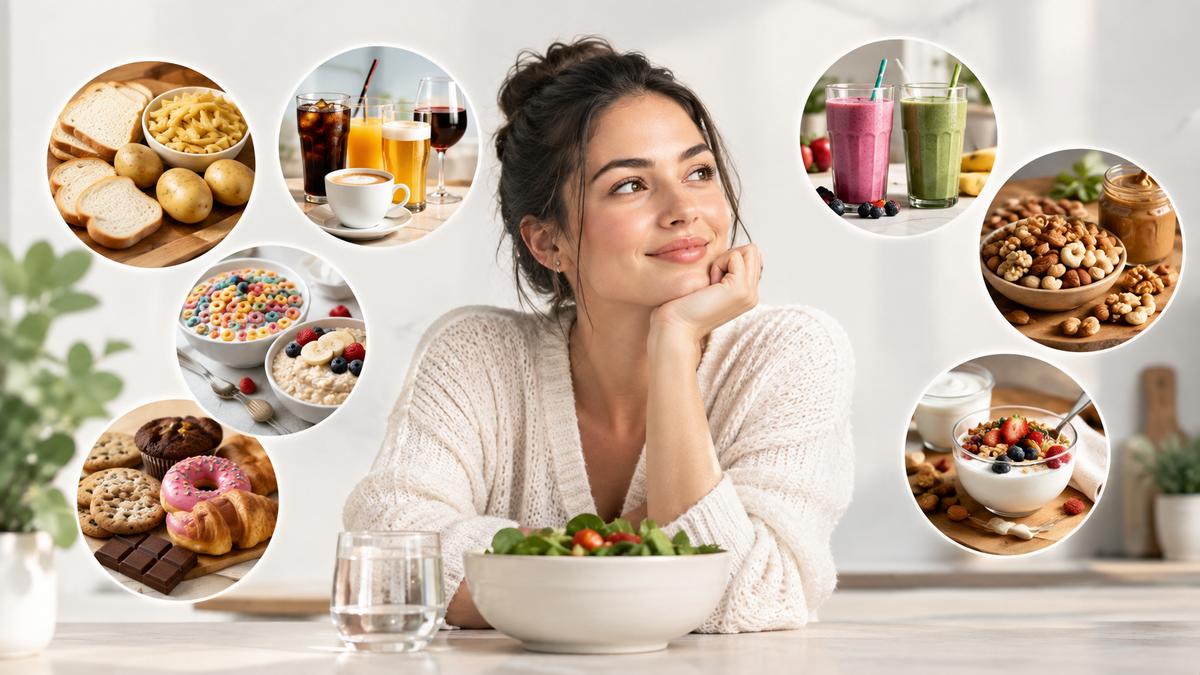
Most people are not gaining weight because they are intentionally eating badly. What often happens is that they are consuming foods and drinks that spike blood sugar, such as some smoothies, or hide calories, like nuts. This is what often causes weight gain.
That said, physiological characteristics do vary from person to person, sometimes significantly. That is why the same diet, the same eating habits, can produce different results from one individual to another. Sometimes, those can vary significantly. Also, note that there is no such thing as a simple list of "foods that make you gain weight." It is much more nuanced than that.
Even so, everyone can benefit from taking this information into account as they make their nutritional decisions since limiting these types of foods and drinks generally improves a person's health, including when any potential impact on weight is not a concern.
Refined flours, such as white bread and some kinds of pasta, tend to be digested fast. This is partially because so much of their grain structure and fiber, both of which slow down digestion, have been removed. Also, starchy foods, like white potatoes, are usually digested quickly as well.
Blood glucose, also known as blood sugar, then rises, resulting in the pancreas releasing insulin, which is what transports that glucose into your cells to give you energy. More to the point, blood sugar and insulin levels tend to be higher as compared to when whole-grain foods are consumed.
The main connection with weight for refined flour and starches is that these types of foods are often easier to eat quickly, resulting in more calories being ingested than expected or intended.
Less-processed foods like whole-grain bread, brown rice and lentils are good alternatives.
Liquid calories are those that are ingested via drinks. Examples include soda, juice, alcohol and coffee, the latter admittedly resulting in few calories if it is only coffee but having much higher calorie counts when it is sweetened.
The main issue here is that liquid energy generally results in overconsumption. Calories that are consumed fast, such as in a few swallows of a drink, tend to cause fewer fullness signals.
One option is to stop drinking orange juice and eat oranges instead. This is partially because juicing removes so much of an orange's fiber. Also, you naturally eat an orange slower than you drink orange juice.
Another is to swap sugar-laden coffee with plain black coffee or at least coffee with a small amount of sugar.
Although breakfast cereal and oatmeal absolutely do have the potential to be healthy foods, the issue is that many people buy cereals that include refined carbs and added sugar as well as instant oatmeal with added sugar. On top of that, they are often marketed as healthy options when there are serious concerns about that statement.
Metabolically, these types of foods tend to be digested fast since they have those added sugars and, in many cases, minimal amounts of protein and fiber.
That said, keep in mind that not all breakfast cereals and oatmeal are like this. Focus your diet on high-protein and high-fiber breakfast cereals as well as less-processed oats that do not have added sugar.
The most significant issue with baked goods and sweets, such as muffins, doughnuts, cake and cookies, is that they usually combine flour, sugar and fat while also contributing minimal amounts of protein and fiber.
The refined starch and added sugar that baked goods and sweets have are also what makes this type of food quickly digested and absorbed by the body. In addition, the fat that they tend to contain contributes to a significant amount of calories being consumed in a relatively small portion of food.
Another way these foods slip by people is that they are often labeled in healthy-sounding ways, such as "blueberry muffin" and "organic pastry."
There are various alternate foods that can be eaten instead, including whole fruits, plain yogurt and baked goods without added sugar.
Smoothies and protein shakes are another category of foods and drinks that are sometimes advertised as being healthy when they are not in many cases. This is the main cause of them slipping past people and being overlooked in relation to potential weight gain.
An important point to note is that smoothies and protein shakes can have high-calorie ingredients or large portions. That can result in you drinking several hundred calories without realizing it.
As for sugar specifically, these types of drinks often have a substantial amount of it. However, value what is already naturally in its ingredients, such as blueberries, strawberries, oranges or otherwise, versus what has been added on top of those types of ingredients.
The simplest swap to make is getting smoothies and protein shakes with no added sweeteners. Otherwise, consider consuming whole foods over smoothies and protein shakes.
Nuts and nut butters are arguably the healthiest examples on this list. The issue here is that they are quite calorie-dense, which can result in people over-portioning them and ending up consuming many more calories than they had expected or realized. For example, around 23 almonds or 14 walnut halves, both weighing about an ounce, consists of around 175-200 calories. Also, 2 tablespoons of nut butter are about the same calories.
Another positive is that nuts and nut butter contain mostly unsaturated fats, which are commonly known as the "good fats." Additionally, they have a high satiety value, which results in people naturally eating fewer of them than is the case with the other items on this list. The main stumbling block occurs when someone has eaten a significant amount of them fast, before receiving those satiety-related signals.
Since nuts and nut butters are healthy foods, the main recommendation is to pre-portion them as well as eat them slower as opposed to swapping them for a different type of food. That is because the hidden calories in healthy foods like nuts are more so hidden because those foods are so calorie-dense.
Low-fat and flavored yogurt presents a few potential issues. One is that removing fat removes the satiety-related benefits of fat while being labeled with the phrase, "low fat," which results in many viewing that product as being healthier. Another is that flavored yogurt tends to include substantial amounts of added sugar.
Related to that is that in many low-fat yogurts, manufacturers have replaced that removed fat with added sugar.
The best practical alternative is plain, unsweetened yogurt, which can be viewed as a weight loss food in a way. You can always add a low amount of sugar to it at home yourself; that amount would likely be significantly less than is in most flavored yogurts. Or simply add whole fruits, such as blueberries, to that plain yogurt.
All of these foods and drinks play roles in weight loss and weight gain. However, keep in mind that there are so many other factors that do so as well, which is why two people can consume identical diets and experience different results. Examples of these other factors include genetics, hormones, sleep quality, insulin resistance and thyroid function.
That is why a generic list of foods, while being absolutely helpful, should not be the be-all and end-all of your approach to your diet. A physician-supervised, individualized approach is an essential option as well, especially if you are asking yourself, "Why am I gaining weight?" and unable to figure it out.
If you would like a consultation and a recommended personalized treatment plan, reach out to Skin Body Health, a physician-led medical spa that has locations in New Orleans and Mandeville. You can contact us through our website or via a phone call.
By Dr. Kelly G. Burkenstock, MD, board certified in Internal Medicine and Anti-Aging & Regenerative Medicine Scroll through TikTok...
Read moreMost people are not gaining weight because they are intentionally eating badly. What often happens is that they...
Read moreEight Amazing Benefits of Collagen Collagen is a crucial component in our hair, skin, nails, bones, muscles, and...
Read more
